What Happens After Death in Hinduism? The Soul's Journey
What Happens After Death in Hinduism? The Soul's Journey
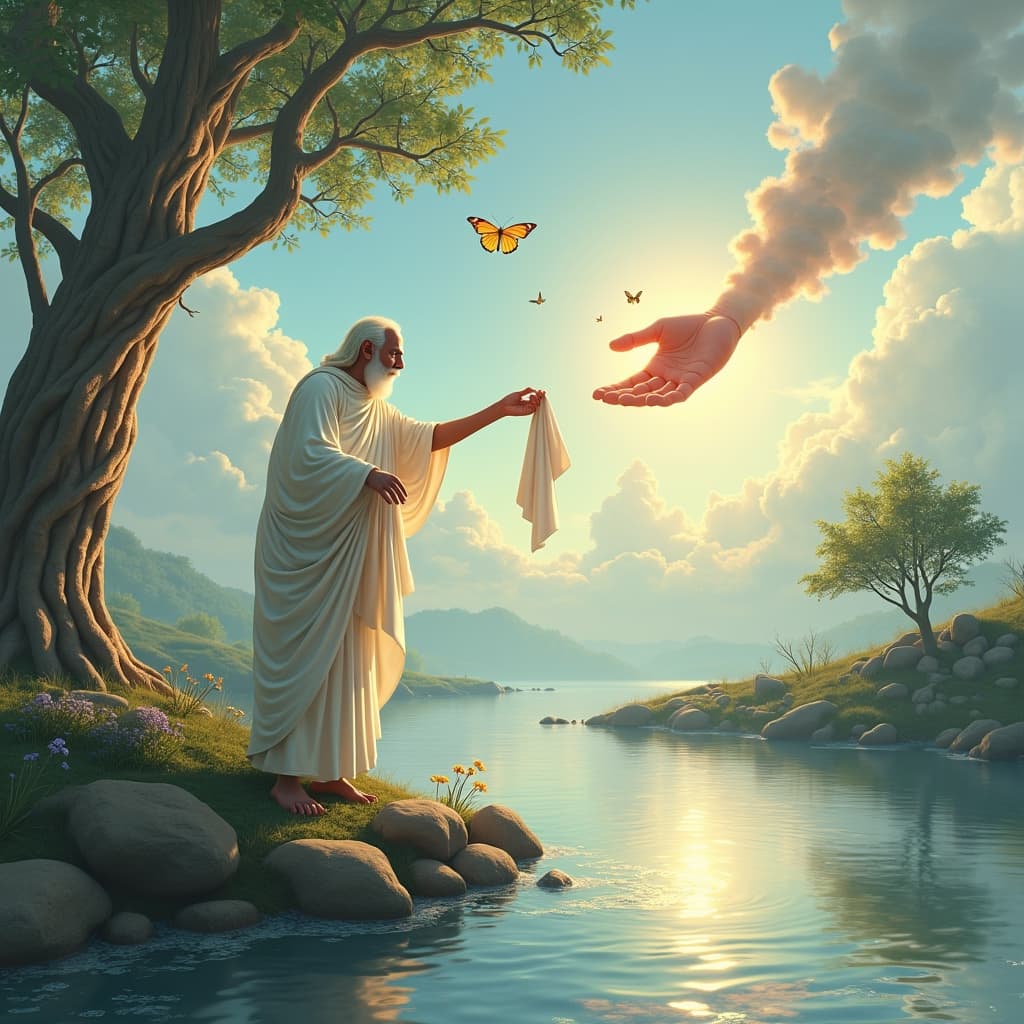
According to Hinduism, death is not the end — it is a transition. The physical body dissolves, but the atman (soul) is eternal and continues its journey. What happens next depends on the karma accumulated across a lifetime: the soul may experience subtle realms of existence, rest in higher or lower planes, and eventually take a new birth. For those who achieve complete self-realization, the cycle ends entirely in moksha — liberation. Hindu philosophy offers one of the most detailed and nuanced frameworks for understanding what awaits after death, drawing from the Bhagavad Gita, the Upanishads, and texts like the Garuda Purana.
The Eternal Soul: Why Death Is Not What We Think
The foundation of the Hindu understanding of death is the nature of the atman — the true self that resides within every living being. Unlike the body, which is born, grows old, and dies, the atman was never born and will never cease to exist.
The Bhagavad Gita states this with striking clarity:
नैनं छिन्दन्ति शस्त्राणि नैनं दहति पावकः।
न चैनं क्लेदयन्त्यापो न शोषयति मारुतः॥
— Bhagavad Gita 2.23
"The soul can never be cut by any weapon, nor burned by fire, nor moistened by water, nor withered by the wind."
This verse — spoken by Lord Krishna to Arjuna on the battlefield of Kurukshetra — is at the heart of what Hinduism teaches about death. The soul is indestructible. What we call "death" is only the departure of the atman from one physical body. Krishna continues with perhaps the most famous metaphor in all of Hindu scripture:
"As a person puts on new garments, giving up old ones, the soul similarly accepts new material bodies, giving up the old and useless ones." — Bhagavad Gita 2.22
From this perspective, grief over death, while natural, reflects a misidentification with the body. The deepest part of who we are — and who our loved ones are — has not been lost.
The Three Bodies and What Survives Death
To understand what happens after death, Hindu philosophy distinguishes between three bodies (shariras):
- Sthula sharira — the gross physical body, made of the five elements (earth, water, fire, air, space). This is what dies and is cremated or buried.
- Sukshma sharira — the subtle body, comprising the mind, intellect, ego, and vital energy (prana). This survives death and carries the impressions (samskaras) and unresolved karma of the lifetime.
- Karana sharira — the causal body, the deepest layer, sometimes described as the seed-body that carries the soul's essential tendencies across many lifetimes.
When the physical body dies, the soul does not float away as a disembodied ghost. Instead, it remains enveloped in the subtle body — an invisible vehicle that stores all the mental and karmic content of the lifetime. This subtle body is what travels, experiences, and eventually enters a new womb.
Where Does the Soul Go? Lokas, Karma, and the Journey Between Lives
Hindu cosmology describes a vast universe of lokas — planes or worlds of existence — ranging from the earthly realm (Bhu loka) to progressively higher or lower realms. After death, the soul's destination is determined entirely by its karma — the accumulated weight of its actions, intentions, and spiritual development.
The Katha Upanishad, one of the most profound of the Upanishads, presents a dialogue between the young Nachiketa and Yama (the god of death) in which the secrets of what lies beyond death are revealed. Yama tells Nachiketa that few people understand the true nature of the atman — most are caught in the assumption that death is simply the end.
Hindu texts, particularly the Garuda Purana (a Mahapurana dedicated to describing the afterlife in detail), describe the journey of the soul in stages:
-
At the moment of death, the prana (life force) withdraws from the body, usually exiting through one of the body's openings. Ideally, spiritually advanced souls exit through the crown of the head (brahmarandhra), associated with liberation.
-
Immediately after death, the soul may experience a period of disorientation as it acclimatizes to being without a physical body. Family prayers, the recitation of scripture, and rituals performed by the living are believed to support the soul during this transition.
-
The journey to Yamaloka, the realm presided over by Yama (the lord of death and cosmic justice). Here, according to tradition, the soul's life is reviewed — not as judgment in the Western sense, but as an accounting of karmic balance.
-
Assignment to an appropriate realm based on karma:
- Souls with predominantly positive karma may spend time in Svarga (a heavenly realm of great beauty and peace) before their next birth.
- Souls with heavy negative karma may pass through Naraka (hellish realms of purification) before being reborn.
- Highly evolved souls may achieve Brahmaloka (the highest plane) or go directly to moksha.
Critically, in Hinduism, both Svarga and Naraka are temporary states, not permanent destinations. They are places where the karmic account is balanced — pleasurable for positive karma, difficult for negative karma — and once the karma is exhausted, the soul returns to be reborn.
The Role of Karma in Determining the Next Life
The conditions of a person's next birth — the family they are born into, their physical and mental tendencies, the circumstances of their life — are shaped by the karma carried in the subtle body from previous lifetimes. This is not punishment but rather the natural unfolding of cause and effect.
Karma in Hinduism is far more nuanced than simple "good deeds get rewarded." Hindu philosophy identifies several types of karma:
- Sanchita karma — the total accumulated karma from all past lives
- Prarabdha karma — the portion of karma "activated" for the current life, which determines the broad outline of one's circumstances
- Agami karma — new karma being created right now through present choices and actions
The direction of the soul after death is set not only by actions but by the dominant state of mind at the moment of death. This is why Hinduism places great emphasis on dying consciously — ideally with the name of God on one's lips, surrounded by prayers and scripture. The Bhagavad Gita (8.6) states that whatever one thinks of at the moment of death, that is where one goes.
Hindu Funeral Rites: Supporting the Soul's Journey
The antyesti samskaras — the last rites of Hinduism — are not merely cultural customs. They are understood to actively support the departing soul in its transition.
Key elements include:
- Cremation (antim sanskar): The burning of the physical body is meant to swiftly release the soul from its attachment to the gross body. The fire element purifies and separates. Most Hindus practice cremation; infants and certain holy persons may be buried.
- The 13-day mourning period: Known as shuddhi (purification), this period involves daily prayers, recitation of Vedic hymns, and the offering of water and sesame seeds (til) to the departed soul. These rituals are believed to help the soul navigate the subtle realms without confusion or fear.
- Shraddha ceremonies: Performed on specific days and especially on the anniversary of death, shraddha rituals offer food and prayers to ancestors (pitrs). Hindu tradition teaches that the living and the departed remain connected, and these offerings nourish the ancestral soul in its ongoing journey.
- Pinda daan: Offerings of rice balls symbolically nourish the subtle body of the departed as it forms its new existence.
The Two Paths After Death: Devayana and Pitriyana
The Chandogya Upanishad and the Brihadaranyaka Upanishad describe two paths the soul may take after death:
Devayana (the path of the gods / the northern path): Taken by those who have pursued deep spiritual knowledge and meditation. This path leads progressively through higher realms toward Brahmaloka, and ultimately toward final liberation (moksha). Souls on this path do not return to be reborn.
Pitriyana (the path of the ancestors / the southern path): Taken by those who performed good deeds and ritual acts, but without complete self-knowledge. These souls ascend to Chandraloka (the lunar realm), where they enjoy the fruits of their merit, and then return to Earth to be reborn. This is the cycle of most souls.
The Upanishads teach that dharma, self-discipline, and the pursuit of self-knowledge determine which path the soul follows.
The Ultimate Goal: Moksha
The entire cosmology of death, afterlife, and rebirth in Hinduism points toward one destination: moksha — liberation from the cycle of samsara altogether. Moksha is not a place but a state of being — the recognition that the individual atman and the universal Brahman are ultimately one.
When a soul achieves moksha, it does not need to be reborn. There is no further karma to work through, no further lessons the cycle of birth and death can teach. The drop returns to the ocean — not dissolved into nothingness, but fully merged with infinite being.
Hindu philosophy on reincarnation frames the entire span of lifetimes as a kind of spiritual education — each birth an opportunity to purify the subtle body, accumulate wisdom, and move closer to that ultimate freedom.
The Katha Upanishad's Nachiketa, having received the teaching of Yama himself, sums it up: the wise person, knowing the atman to be deathless, does not mourn. They live fully, act righteously, and move steadily toward the realization that liberates.
How This Teaching Changes How You Live
What's remarkable about the Hindu view of death is how profoundly it shapes the living. If the soul is eternal, death loses its sting — not through denial, but through genuine understanding. Grief is natural and human. But the deepest response to death, the Hindu tradition teaches, is not despair but viveka — discernment — the ability to distinguish the permanent from the impermanent.
This means:
- Living each day with awareness that your actions create karma that shapes your future
- Treating this lifetime as an opportunity, not a burden
- Supporting loved ones at the time of death with prayers and presence, knowing the soul continues its journey
- Cultivating the spiritual practices that accelerate the soul's progress toward liberation
Frequently Asked Questions About Death in Hinduism
Q: What does Hinduism say happens to the soul after death?
A: The soul (atman) is eternal and does not die. After the physical body dies, the soul continues in the subtle body and eventually takes a new birth based on accumulated karma. The cycle continues until the soul achieves moksha (liberation).
Q: Where does the soul go immediately after death in Hinduism?
A: Hindu texts describe the soul traveling to various realms based on karma. Pure souls may ascend to higher lokas (planes) or move toward moksha. Souls with unresolved karma experience subtle planes before taking another birth. The Garuda Purana describes this journey in great detail.
Q: What is the significance of Hindu funeral rites after death?
A: Hindu funeral rites (antyesti samskaras) help the departing soul transition smoothly. Cremation releases the soul quickly from attachment to the physical body. The 13-day mourning period with prayers and rituals supports the soul's journey in the subtle realms.
Q: Do Hindus believe in heaven and hell?
A: Yes, but differently from Abrahamic traditions. Hindu cosmology includes Svarga (heavenly realms) and Naraka (hellish realms), but these are temporary states — not permanent destinations. After experiencing the fruits of karma, the soul is reborn to continue its spiritual journey.
Q: What is moksha and how does it relate to death in Hinduism?
A: Moksha is liberation from the cycle of birth, death, and rebirth (samsara). When a soul achieves complete self-knowledge and is freed from all karma, it merges with Brahman (ultimate reality) and is no longer subject to rebirth. It is the ultimate goal of Hindu spiritual practice.
Explore the Hindu understanding of death, the soul, and liberation further with the Vedas AI app — your AI-powered guide to the Bhagavad Gita, Upanishads, Vedas, and all of Hindu philosophy. Ask questions, receive personalized insights, and connect ancient wisdom to your daily life. Download free on iOS.
Continue Reading:
Get Vedic Wisdom in Your Inbox
Join our free 5-day email course — one powerful teaching per day from the Bhagavad Gita, Vedas, and Upanishads, with a practice you can try in under 5 minutes.
Explore These Teachings
Download Vedas AI to dive deeper into Hindu wisdom with personalized guidance and daily insights.
Download Vedas AIRelated Articles
April 3, 2026
What Is Karma? Hindu Meaning, 3 Types & Examples
Karma isn't 'what goes around comes around.' Learn the real Hindu meaning, 3 types of karma, and how intention — not jus...
Read More →
April 8, 2026
What Are the Upanishads? Hinduism's Secret Teachings
The Upanishads are Hinduism's ancient philosophical texts that reveal the nature of the self and ultimate reality. Explo...
Read More →
April 2, 2026
What Is Dharma? Hindu Meaning, Types & Purpose
Dharma is the cosmic law and personal duty at the heart of Hindu life. Learn its meaning, the 4 types, and how to discov...
Read More →