What Are the Upanishads? Hinduism's Secret Teachings
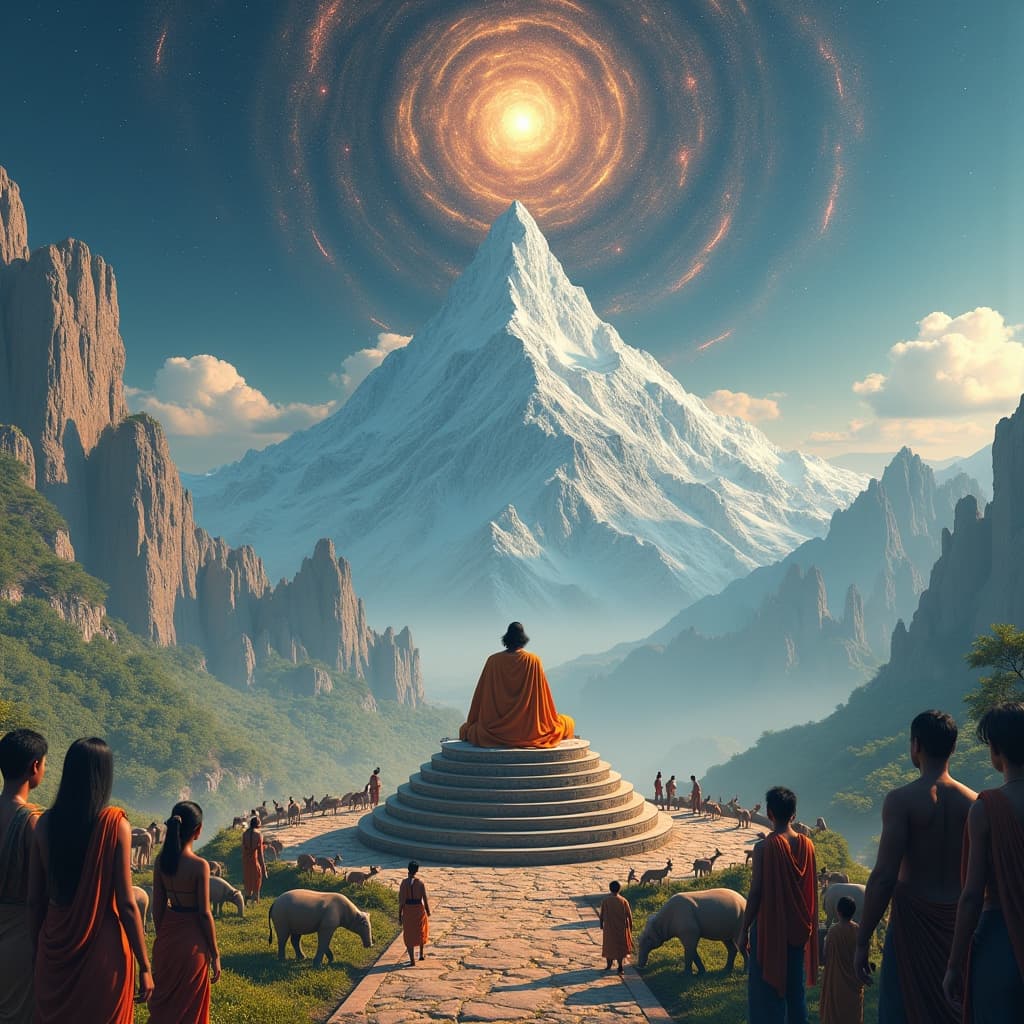
What Are the Upanishads? Hinduism's Secret Teachings
The Upanishads are a collection of ancient Sanskrit texts — composed between roughly 800 and 200 BCE — that form the philosophical heart of Hinduism. Sometimes called the "secret teachings" or the "end of the Vedas," they are where Hinduism's deepest questions live: Who am I? What is the nature of reality? What is the relationship between the individual soul and the universe? If you've ever wanted to understand what Hindu philosophy is really about at its core, the Upanishads are the place to start.
The Name and Its Meaning
The word Upanishad (Sanskrit: उपनिषद्) is composed of three parts: upa (near), ni (down), and shad (to sit). The full meaning is something like "sitting down near" — a student drawing close to a teacher in intimate, direct transmission of wisdom. This naming reflects the original context: these were teachings given in forest hermitages, from realized masters (gurus) to qualified students (shishyas), in conditions of trust, silence, and deep inquiry.
This stands in contrast to the earlier, more ritual-oriented portions of the Vedas. The Upanishads were not meant for mass public recitation — they were secret in the sense of being sacred, reserved for those who had prepared themselves through ethical discipline and genuine spiritual longing.
The Upanishads are collectively known as Vedanta — literally "the end of the Vedas" — because they represent the culmination of Vedic thought. They conclude the four Vedas (Rig, Sama, Yajur, Atharva) and transform their outer rituals into inner inquiry.
Origins: When and How Were They Written?
The Upanishads belong to the oldest layer of Hindu scriptures. Scholars date the earliest Upanishads — such as the Brihadaranyaka and Chandogya — to around 800–600 BCE, though the oral traditions behind them are likely much older. Later Upanishads were composed well into the Common Era, with some classical texts dating to 500–1000 CE.
There are traditionally 108 Upanishads in total, though only about 13 are considered principal (mukhya) Upanishads and form the main source for classical Vedanta philosophy. These include:
- Brihadaranyaka Upanishad — The oldest and longest; explores Brahman, the self, and the nature of death
- Chandogya Upanishad — Contains the famous declaration Tat Tvam Asi ("That thou art")
- Mandukya Upanishad — Only 12 verses; analyzes consciousness through the four states of waking, dreaming, deep sleep, and transcendence
- Kena Upanishad — Asks: by what power do the mind and senses function?
- Katha Upanishad — A dialogue between a young boy, Nachiketa, and the god of death, Yama — on the nature of the eternal self
- Mundaka Upanishad — Distinguishes between lower knowledge (ritual, science) and higher knowledge (self-realization)
- Isha Upanishad — Only 18 verses; reconciles action and renunciation in a unified vision
The Axial Age Context
The Upanishads emerged during what historians call the Axial Age — the same period that gave birth to the teachings of the Buddha in India, Confucius in China, Socrates in Greece, and the Hebrew prophets in the Middle East. There was something in the human spirit, across cultures, that began asking: What is the nature of the self? How should I live? What is real? The Upanishads represent India's most systematic and profound attempt to answer those questions.
The Core Teachings: Atman, Brahman, and Their Unity
At the center of Upanishadic teaching are two concepts: Atman and Brahman.
Brahman (ब्रह्मन्) is the ultimate reality — the infinite, unchanging ground of all existence. Not a god who sits somewhere judging humanity, but the underlying consciousness and being from which all phenomena arise and to which they return. Brahman is described as Sat-Chit-Ananda: pure existence (sat), pure consciousness (chit), pure bliss (ananda).
Atman (आत्मन्) is the innermost self — not the ego, personality, or body, but the pure witnessing awareness at the core of every individual. What you truly are, stripped of every label, role, and temporary characteristic.
The radical and liberating insight of the Upanishads is that Atman and Brahman are ultimately the same. The individual self and the universal self are not two separate things but one undivided reality. This teaching is captured in four great declarations known as the Mahavakyas (great sayings):
"Tat Tvam Asi" — That thou art. (Chandogya Upanishad, 6.8.7)
The ultimate reality (That) is identical with what you most deeply are (Thou).
"Aham Brahmasmi" — I am Brahman. (Brihadaranyaka Upanishad, 1.4.10)
"Prajnanam Brahma" — Consciousness is Brahman. (Aitareya Upanishad, 3.3)
"Ayam Atma Brahma" — This Self is Brahman. (Mandukya Upanishad, 1.2)
These are not statements of ego or arrogance — they are declarations of the deepest metaphysical truth. You are not merely a body or a personality moving through a material world. You are, at the most fundamental level, an expression of the infinite consciousness that underlies all of reality.
What Makes the Upanishads Different From Other Hindu Texts
The Upanishads occupy a unique position among Hindu scriptures. While the earlier Vedic hymns focus on ritual, cosmic order, and the relationship between humans and gods, the Upanishads turn the inquiry inward. They ask: What is the observer behind all observation? Who is the one doing the thinking?
This is quite different from the narrative style of texts like the Bhagavad Gita or the Puranas. The Upanishads are raw philosophical inquiry — often in the form of dialogues, riddles, and direct pointing. They challenge the student to think, question, and ultimately transcend thinking.
It's worth noting that the Bhagavad Gita — perhaps the most beloved Hindu scripture — is deeply influenced by the Upanishads. When Krishna tells Arjuna that the self is eternal, unborn, and undying, he is directly drawing on Upanishadic metaphysics. Understanding the Upanishads enriches your reading of the Gita enormously.
The Upanishads also differ from the moral and ethical frameworks found in discussions of dharma or karma. Dharma and karma operate within the world of action and consequence. The Upanishads step back and ask: who is the one acting? What is the nature of the one who accumulates karma? Their answer — the eternal, unchanging Atman — is the foundation beneath all Hindu ethics and practice.
How to Approach the Upanishads Today
The Upanishads are not easy texts to simply read on a Sunday afternoon. They were composed for direct transmission — they assumed a teacher, a student, and a living relationship. That said, they are absolutely accessible to modern readers with the right approach.
Here are a few ways to engage with them meaningfully:
- Start with accessible translations. Eknath Easwaran's translations of the major Upanishads are widely praised for balancing accuracy with readability. Swami Nikhilananda's four-volume set is more comprehensive. Patrick Olivelle's scholarly edition is excellent for historical context.
- Begin with shorter texts. The Mandukya Upanishad (12 verses), the Isha Upanishad (18 verses), and the Kena Upanishad are ideal entry points — small, concentrated, and profound.
- Read slowly, not quickly. A single verse of the Upanishads can be meditated on for weeks. This is not content to consume; it is inquiry to inhabit.
- Look for what resonates, not what you can immediately explain. The Upanishads often work more like koans than arguments — they point at something that must be experienced directly, not just understood intellectually.
- Use commentaries. The philosopher Adi Shankaracharya (788–820 CE) wrote brilliant commentaries on the principal Upanishads that are themselves classics of Indian philosophy. His Advaita Vedanta (non-dual Vedanta) interpretation remains the most influential reading of the texts.
The Three Schools of Vedanta
The Upanishads gave rise to three major philosophical schools in Hinduism, each offering a different interpretation of the Atman-Brahman relationship:
- Advaita Vedanta (Adi Shankaracharya): Atman and Brahman are absolutely identical. Only Brahman is real; the apparent multiplicity of the world is maya (illusion or creative power).
- Vishishtadvaita (Ramanujacharya): Atman and Brahman are one but distinguished — the individual self is a real mode of Brahman, like waves on the ocean.
- Dvaita (Madhvacharya): Atman and Brahman are fundamentally distinct. Liberation is eternal closeness to God, not dissolution into God.
All three schools trace their roots directly to the Upanishadic texts — which shows just how rich and multivalent these teachings are.
Exploring the Upanishads in the Vedas AI App
The Upanishads' core questions — Who am I? What is consciousness? What is real? — are exactly the kinds of questions the Vedas AI app is designed to help you explore. Within the app, you can ask questions drawn directly from the Upanishadic tradition:
- "What does Tat Tvam Asi mean, and how does it apply to my life?"
- "What's the difference between Atman and ego?"
- "How does Advaita Vedanta understand the nature of consciousness?"
- "Which Upanishad should I read first?"
The app draws from the primary Upanishads, classical commentaries, and the broader tradition of Vedanta to give you grounded, thoughtful answers — not abstract summaries, but responses that meet you where you are.
Frequently Asked Questions About the Upanishads
Q: How many Upanishads are there? A: Tradition recognizes 108 Upanishads, but only 13 are considered "principal" (mukhya) and form the foundation of Vedanta philosophy. The most studied include the Brihadaranyaka, Chandogya, Mandukya, Katha, and Isha Upanishads.
Q: Are the Upanishads part of the Vedas? A: Yes. The Upanishads are the concluding philosophical sections of the four Vedas — they are sometimes called the Vedanta, meaning "end of the Vedas." While the earlier Vedic texts focus on ritual and cosmic order, the Upanishads shift the focus entirely inward, toward self-inquiry and ultimate reality.
Q: What is the main difference between the Upanishads and the Bhagavad Gita? A: The Bhagavad Gita is part of the epic Mahabharata and uses narrative and dialogue to teach — it's more accessible and emotionally engaging. The Upanishads are direct philosophical inquiry, often in a question-and-answer format between teacher and student. The Gita is deeply influenced by Upanishadic thought: they share the same core insight about the nature of the eternal self.
Q: Do you need to be Hindu to study the Upanishads? A: Not at all. The Upanishads address universal questions about consciousness, identity, and reality that belong to no single tradition. Thinkers as varied as Arthur Schopenhauer, Ralph Waldo Emerson, and Nikola Tesla have drawn inspiration from Upanishadic wisdom. Their insights are available to any sincere seeker.
Q: What is the central message of the Upanishads in one sentence? A: The deepest truth about you — your innermost self — is identical with the ultimate reality of the universe. You are not separate from the infinite; you are an expression of it.
Explore the Upanishads further with Vedas AI — your AI-powered guide to the Bhagavad Gita, Vedas, Upanishads, and all of Hindu philosophy. Ask questions, get personalized insights, and connect ancient wisdom to your daily life. Download free on iOS.
Continue Reading:
Get Vedic Wisdom in Your Inbox
Join our free 5-day email course — one powerful teaching per day from the Bhagavad Gita, Vedas, and Upanishads, with a practice you can try in under 5 minutes.
Explore These Teachings
Download Vedas AI to dive deeper into Hindu wisdom with personalized guidance and daily insights.
Download Vedas AIRelated Articles
April 13, 2026
What Happens After Death in Hinduism? The Soul's Journey
Hinduism teaches that death is not the end. Learn what happens to the soul after death, the role of karma, and the path ...
Read More →
April 6, 2026
Bhagavad Gita Explained: A Clear Beginner's Guide
New to the Bhagavad Gita? This guide breaks down its 700 verses, 3 yoga paths, and life-changing teachings on duty and l...
Read More →
April 3, 2026
What Is Karma? Hindu Meaning, 3 Types & Examples
Karma isn't 'what goes around comes around.' Learn the real Hindu meaning, 3 types of karma, and how intention — not jus...
Read More →